

Time Was Crucial for Oroville Hospital Stroke Patient’s Recovery
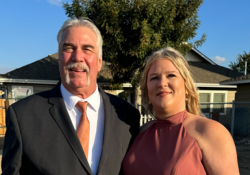
On Nov. 9, 2024, Dawn Abel woke in the middle of the night, unaware that she was having a stroke. Her husband, Robert, saw that her face was drooping on the left side and immediately recognized it as a tell-tale symptom.
He called 911 and an ambulance rushed Dawn to Oroville Hospital – just a 10-minute drive from her home. As an American Stroke Association-designated Primary Stroke Center, the hospital had specially trained clinicians, already alerted by the EMTs in the ambulance, waiting in the emergency room to evaluate her. A CT scan indicated that a clot in a blood vessel in her brain was the cause of her stroke.
Because Dawn had other medical issues that prevented her from receiving a highly effective clot-dissolving drug known as tPA that can be administered to eligible patients at primary stroke centers, the Oroville Hospital team quickly arranged for her to be flown by helicopter to a Sacramento-area medical center. There, a complex surgical procedure was performed to remove the clot.
“They were very attentive to me at Oroville Hospital when I got to the ER,” Dawn recalled. “It’s all kind of a blur but I remember being whisked away to the CT scanner and then the helicopter arriving really fast after that. The primary stroke center team intervened quickly and got me to where I needed to go.”
Every stroke is a race against time. For each minute a stroke goes untreated, nearly 2 million brain cells die. Primary stroke center clinicians are trained to quickly assess patients and administer clot-dissolving medication to restore critical functions in eligible stroke patients who might otherwise have been left with more severe, permanent brain damage. When a higher level of care is needed, the primary stroke center team can rapidly coordinate the patient’s transfer to other medical centers.
Six weeks after having the stroke, Dawn returned to her position as Executive Nurse Director of the Oroville Hospital Post-Acute Center. She had made such a strong recovery that it was determined she didn’t need any rehab care. Today, while most of her critical functions are restored, she still suffers from some ill effects, including neurological fatigue – a kind of brain fog – and impaired spatial awareness.
As a nurse practitioner herself, Dawn knows just how fortunate she was that the stars aligned for her that night. First, that Robert realized she was having a stroke and immediately dialed 911. Second, that, as a primary stroke center, Oroville Hospital had an experienced stroke team ready to coordinate her care as soon as she arrived at the ER.
“I know that things could have gone very differently for me if Robert hadn’t acted so quickly and if the primary stroke center hadn’t been so close at hand,” Dawn said. “I wouldn’t be where I am now if they hadn’t responded to me in the ER as quickly as they did. It could have been far worse. When you’re having a stroke, time is crucial."